
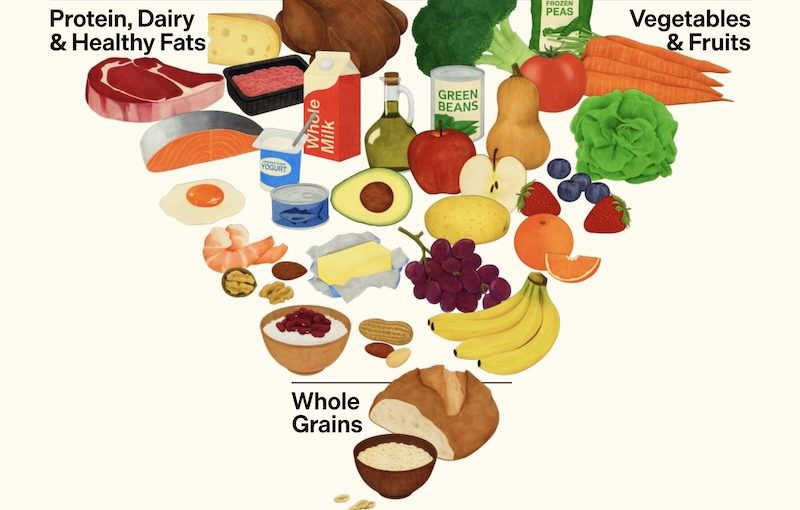
America just adopted our motto: ‘Eat Real Food.’ Meanwhile, NZ moves in the opposite direction. The timing is… interesting.
Summary:
- USDA admits 45 years of dietary guidelines failed
- New message: “Eat real food, avoid ultra-processed foods”
- Meanwhile, NZ is ending our 30-year GMO-free status
- 97% of submissions opposed it. Passing anyway
I hope the mainstream adoption of real food won’t do to food what yoga pants did to yoga.
Here’s why I’m skeptical, and why you should pay attention.
Yesterday, on January 7, 2026, the United States Department of Agriculture released its 2025-2030 Dietary Guidelines with a radical message: eat real food, avoid ultra-processed foods.
The core message, repeated throughout the document: “Eat real food.”
Now, we’ve all heard the joke: “How do you know when a politician is lying? Their lips are moving.” The US government may be saying “eat real food,” but it’s likely those are empty words. It’s politics, after all. But let’s amuse ourselves for a moment and imagine it actually influences policy.
What the Guidelines Actually Say
The new USDA guidelines don’t mince words. Here’s what they recommend:
Foods to Avoid:
- “Highly processed packaged, prepared, ready-to-eat foods”
- “Foods and beverages that include artificial flavors, petroleum-based dyes, artificial preservatives, and low-calorie non-nutritive sweeteners”
- Sugar-sweetened beverages
- Refined grains and starches (which they flatly state “are sugar”)
- Ultra-processed foods that “currently account for about two-thirds of the energy consumed in the U.S.”
Foods to Prioritise:
- “Whole vegetables and fruits in their original form”
- Quality protein (1.2-1.6g per kg body weight daily)
- Fermented foods for gut health
- Nutrient-dense, naturally occurring foods “without added sugars, industrial oils, artificial flavors, or preservatives”
And here’s the kicker: “The U.S. is experiencing a largely preventable epidemic of chronic metabolic disease… these 10 sets of recommendations [1980-2020] have failed to effectively counter the rising tide of chronic diseases.“
The USDA just admitted 45 years of dietary guidelines failed. Not “could have been better.” Failed.
Whether they actually follow through remains to be seen. Politicians talk. We’ll see if they walk.
The Pioneers Have Been Validated
In 2008, Michael Pollan published In Defense of Food and distilled his entire philosophy into seven words:
Eat food. Not too much. Mostly plants.
He argued against what he called “edible food-like substances”: The processed, engineered products that fill supermarket shelves. He was dismissed as an elitist, a fringe voice.
Yesterday, every major news outlet covering the USDA guidelines quoted that exact phrase.
The Missing Piece
The USDA guidelines focus on “high-quality, nutrient-dense protein” but there’s no mention of organic. No mention of regenerative agriculture. No mention of how animals are raised.
This matters because meat, dairy, and eggs accumulate whatever’s in their environment: both nutrients AND toxins. Factory-farmed animals raised on antibiotics, hormones, and GMO feed in confined spaces don’t produce the same food as pasture-raised animals eating their natural diet.
Conventional farming is also an environmental disaster.
If these guidelines lead to increased meat consumption without changing how that meat is produced, we’re just trading one health crisis for another.
The USDA recommends eating real food, but they’re silent on whether that food should be raised in real conditions.
“100% Pure”: The New Zealand Irony
While the United States, land of corn syrup and 73% obesity, releases guidelines saying “eat real food,” what’s New Zealand doing?
We’re weeks away from passing the Gene Technology Bill:
- Ends our 30-year GMO-free status
- No labelling requirements
- 97% of 14,458 submissions opposed it
- Passing anyway
America spent 45 years promoting processed food, admitted it failed, and is reversing course.
New Zealand has been GMO-free for 30 years. It’s one thing we got right. Now we’re trading places.
Your Body Doesn’t Care About Politics
Whether you think the USDA is right or wrong, whether you support the Gene Technology Bill or oppose it, whether you believe politicians when they talk… Your body doesn’t care.
It cares about what you feed it.
Humans evolved on real food. It’s only since WWII that scientists and corporations started mucking with it. As the USDA admits, we’re now experiencing “a largely preventable epidemic of chronic metabolic disease.“
That’s why at Bliss Box we’ve been delivering real food in NZ for years; organic and spray-free, locally sourced, grown right.
Too Good to Be True?
Personally, I don’t give much regard to government promises or centralised solutions, but it is nice for a change to see the mainstream finally admitting what we’ve been fighting for since the turn of the millennium.
At the same time, I can’t help thinking about the Oscar Wilde quote: “Whenever people agree with me I always feel I must be wrong.“
As much as I’d love to see an additive-free world of nutrient-rich locally grown food, I remain a bit suspicious.
That is, if these guidelines have any real effect at all.
Take control of your own health. We’ll be here delivering boxes of real food to real people who do.
Frequently Asked Questions
What do the 2025 USDA guidelines say?
Eat real food. Avoid ultra-processed foods, artificial ingredients, and added sugars.
What is NZ’s Gene Technology Bill?
Legislation ending New Zealand’s 30-year GMO-free status, allowing gene-edited organisms without labeling.
When does the Gene Technology Bill pass?
Second reading expected in early 2026.
The new US Dietary Guidelines may not have gone as far as we think they could have, and I agree there are a lot of major issues with the way they farm food, but I think they are a big (and surprising) step in the right direction!
Indeed. Look to the positives!
I wish NZers would stop referring to the government to make decisions for us. Common sense is organic foods.
It is alarming disappointing that our government sees fit to tamper with labelling – it’s our rights as citizens of a democracy to be informed of what we are considering eating. Our government is following Great Britain’s authoritarianism lead, even now when we see that this path leads to the destruction of our free country and democracy. It may seem a small thing but this law change undermines what we see as the role of government, from governors to absolutist decision makers.
One of my long-time heroes and pioneers of regenerative agriculture, Joel Salatin, was asked what he’d change if he was the boss of USDA (or “US-Duh”, as he calls it) for one day. He said he’d abolish it, or at the very least insist on 100% consumer transparency. He believes very few people would buy conventional food if they actually knew and understood how it was harming them. At the same time real food could be priced better without over-regulation.